For the most part.
See, there's one** thing, one main thing that grates under my skin when I watch it. And the problem is, it's established so damn thoroughly in the pilot, I seek it out every time I watch a new episode, so that stuff that would be more innocuous otherwise gets to me.
CONSIDER THIS YOUR SPOILER WARNING, FOLKS

Six highschool friends that have been estranged for two years over the death of a seventh member of their pack end up, through some rather realistic happenstance, hanging out together "like old times" while their parents hold a meeting for a group called Pride. Pride, as is presented, is a charity organization all of the parents founded before their kids were born, meeting once a year at the house of one of the families, the Wilder's. By more happenstance, the kids end up going through a secret passage and observing their parents, wearing deep red robes, participating in some sort of cult-like ritual involving what looks like a human sacrifice. The series follows both the parents as their motivations and desires are explained, as well as the kids as they try to figure out what they saw, why it happened, and how to deal with it. On the way, we find out that each of the kids has either a special power or skill that essentially helps them progress in their quest of figuring out what the Hell is going on.
Some things really going for this, first, and in no particular order:
- A very diverse cast. One thing I particularly like about this is that the individual cultures of each family's ethnicity are subtly and organically included: The Minoru parents go out for "real sushi" and have some artifacts that look they're authentically Japanese; Geoffrey, the father of the Wilder family, is a former gangster who discusses that lifestyle in very real ways (and we also get some good snapshots of what that looked like, as well as how it follows him in his "legit" life***); the Yorkes are Jewish but aren't stereotypes that use Yiddish and complain about things not being Kosher or what-have-you; the women in the show seem to be the bigger power-players when it comes to the parents, and there are literally double the number of girls vs. boys in our group of teens.
-The parents themselves have great character development. Not all of them- the Yorkes seem to serve as a constant source comic relief, and Leslie Dean's backstory seems to be on the slow burn path, but pretty much all of the other parents have interesting roles to play and show multiple sides and personalities, especially Tina Minoru and Victor and Janet Stein.
-A realistic depiction of an abusive relationship. The Stein household is fraught with pain and anger, and the way both Chase and his mom, Janet both simultaneously love and fear Victor, the way they keep hoping he'll change, is incredibly and tragically lifelike. We're shown that Victor genuinely does love his family more than anything, but that he has a dark side that rages against them and doesn't comprehend how to deal with that intense love and the magnitude of other feelings he may have towards them as a result of that love. While we're led to believe the Big Change in Victor (that lasts less than a whole episode) is a result of some Jonah Magic, Chase shouts, "You did it again! You made me believe you've changed!" at Victor when the old demons show themselves again at the end of E8 (and earlier in the episode, Robert says Janet is "caught up in the cycle of abuse,") so it's made clear this is hardly the first time Victor as put on a gentle face to keep his family.
-Slow burn! I like a mystery, even though I'm terrible at solving them! Having so many hints dropped is tantalizing, sure. But the fact that they do actually get resolved keeps me coming back, especially when they add more bits and pieces that need unwrapping. If they just kept dumping confusing and unexplained junk onto the audience, I'd be turned off (I'm looking at you, J.J. Abrams), but that's not what's going on at all.
-Realistic teenagers. For the most part (see my second endnote), I think the teenagers are actually depicted fairly well-rounded and authentically. I especially think the hurt they all demonstrate over the loss of Amy (before the series starts) is especially poignant- so far, at least, we aren't told why Alex didn't attend her funeral, and I actually like that. And the fact that Amy's death seems to be what drove the group apart is a sad but understandable plot point. Each kid dealt with it in different ways- Nico turned Wiccan/goth, Alex bared down on the hacking, Chase went full-on jock, Gert became a self-proclaimed feminist and SJW, Karolina started spending even more time at the church, and Molly seems to have kind of stagnated emotionally (no doubt because on top of losing a close friend, she was already an orphan).
Okay, but The Problem. And I think this sums it up:

I noticed almost immediately that any time Gert made a comment she, as a character, intended to point out some sort of injustice or inequality, it was played for eyerolls and to make her, or rather her point, look annoying and act as kind of a killjoy. Sort of following the "feminists/SJWs don't like nice things" vein. And that's a serious problem, especially given that, ostensibly, the show is about diversity and acceptance, among other things- I mean, like I said, the cast is organically diverse.
If you're unfamiliar with the concept of "straw feminist," I highly recommend you watch this video- whether you agree with Anita Sarkeesian or not+, she does a great job of explaining the concept and gives some solid examples to help you understand what it is, as well as why it's a problem.
This is the exact kind of stuff Gert says in Runaways- her friends/adopted sister are doing something innocuous or understandable/expected of a teenager, and she makes a comment that comes across as mean-spirited and deflating, but under the guise of "feminism." What's most damaging about this, though, is that there is validity to what she's saying each time, and in a different context, it would be entirely appropriate and necessary. But when it happens onscreen for us, it just presents her as an asshole that likes to harsh everyone else's mellow. I went back and rewatched the seven episodes that are up as of now, and took notes/quotes. And what I discovered is that in the first episode, I was able to fill almost an entire page of a spiral notebook with relevant quotes/situations. It varies in amount from episode to episode after that, but every episode has at least one or two zingers. And while I won't go through and recount every single one, I'll share a few and why they're both valid but problematic. Let's just start with the pilot.
SCENE: Gert and her adopted sister Molly are getting dropped off at school by their parents. Molly, who is a few years younger, is upset because she has seriously bad cramps, and, after an embarrassing remark from Mom about her using an orgasm to relieve the pain, she tries to change the subject by cheerily saying, "Dance Squad tryouts are today!"
Gert responds, looking super disgusted, "Ugh, Dance Squad is just cheerleading without pom-poms. You're just reinforcing hegemonic masculinity while marginalizing women's identities."
Big Word Vomit aside, these are pretty much the first lines we get from Gert, and they're her using feminist critique to be mean to her younger sister. And, the thing is, there is something to be said about the jock-cheerleader-dynamic and its role in gender structures for youths (and professional athletes, for that matter), and yes, that is an important conversation to have, especially with a young woman that wants to participate. But not like that. Not the way it's shown here, not when its purpose is to essentially bully one's younger sister. It makes the whole idea of questioning the gender and social structures of high school seem like a, well, a dick thing to do.
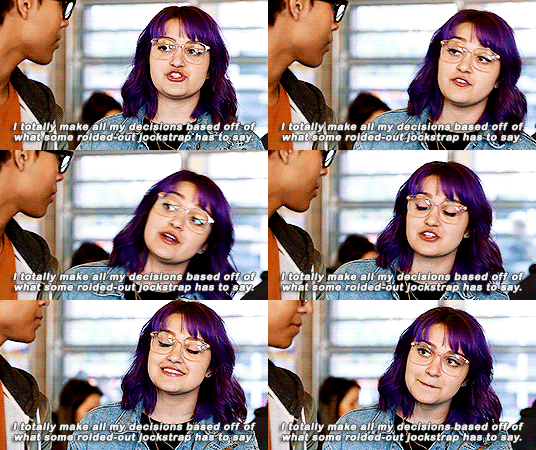
So this is a pretty shitty first impression of Gert. And the rest of the episode, most of her dialogue or actions somehow involve her either being somewhat hypocritical or a flat-out mean-spirited killjoy. She advertises a new club she's trying to start called "Undermining the Patriarchy," but then later reduces Chase to, and these are her exact words, "some roided out jockstrap" whose opinions only go as far as "what protein butter to use," while at the same time, objectifying him by staring creepily at his ass while following behind him as he's talking to one of his teachers. And this is just the first episode.
And okay, if you've read far back enough in my posts, you would know that I'm Lakota Sioux on my mom's side. And yeah, it pissed me off when she said it. But not at all you white folks. At the writers. Because it is true that the US was founded on murder and thievery and deception. That's a legit point, one that matters a HELLUVALOT to gals like me. And there are appropriate times to bring up how Thanksgiving is an easy way for people whose ancestors did the murdering and thieving and deceiving to feel better about/ignore their history (dare I say... whitewash the thing? Eh?), while at dinner with your friends isn't. Not to be persnickety, but that's not the sort of thing you do during the event, you do it when invited and are politely declining. Or if you go, you don't bring it up, because it's pretty damn hypocritical for you to be actively partaking in Thanksgiving while disparaging it and its origins and all that jazz.
Also, of all the people to direct that remark to, it's Alex. The Black kid. The kid whose ancestors were prooooobably slaves? Yeah, sure, blame his ancestors. Just plain tactless.
I digress... So once again, the real, valid point she's making is doing nothing to make viewers question the relevant geopolitical structures, but rather it's just making her look like an asshole that's entirely unconcerned for the social dynamics of the context in which she's in at the moment- and, in certain minds, no doubt, making them question the validity of her claims, rather than said geopolitical structures. Because it's made clear she understands things like conventional etiquette throughout the series; she just deliberately makes people uncomfortable with her "social critiques." And as this particular jab was about indigenous rights, I initially took it probably a little more personal than I should have. But when removing my personal baggage from the picture, it's disconcerting that a promo meant to draw in new customers that gives each character two lines at most, that its picture of Gert is one of mean "social justice warrior."
Another angle she takes is "religious oppression." In the first couple episodes, she comes down hard on Karolina a few times about her family's religion, the Church of Giborrim. And it's juxtaposed against the other characters' perspectives, too. For example, in this same episode, Alex respectfully says he doesn't want to "interfere with [Karolina's] religion" by causing a scheduling conflict, an act of respect for Karolina's faith. And Karolina herself constantly talks about how genuinely happy her faith makes her because it's "positive and life-affirming," teaches her to see beauty and light in everything, everyone, and every situation. Gert, meanwhile, scoffs at the classification of "religion" for the Church of Gibborim, and asserts that "no institution has been as oppressive to women as organized religion."
And so again, the rub:
Organized religion does have a shitty history in: re women.
But instead, when she calls the Church of Gibborum a "cult" and says it's oppressive, she's bullying Karolina and insinuating she's stupid and duped, yet also complicit in the wrongdoing of all organized religion, and deceitful because she just "walks around with fake smiles, pretending to be happy all the time." So even though, sure, a legitimate critique of organized religion is absolutely necessary for good, inclusive feminist theory, Gert uses it as ammo to be cruel to someone she used to call a friend. And she reduces Karolina down to an antifeminist who only cares about "being a perfect church girl."
And what's hard is that it's made pretty obvious that most of her digs at Karolina are motivated out of jealousy because Chase shows signs of having, y'know, feelings for Karolina, while Gert has them for him. The most utterly disgusting bit of it comes across as passively homophobic, too.
In episode six, the kids are planning how to get to a party/gala thing Pride is putting on, and there's some talk about limos. Alex and Nico, who, at this point, are a fairly sold Thing, are going to take a limo together, and when Chase offers to get Karolina in his own, Gert says, "Ugh,

Like, what the actual fuck? So what, queer people don't date? The writers co-opt the language of feminism to make a horrible blanket statement that disregards the experiences of GOD KNOWS HOW MANY NON-BINARY COUPLES/RELATIONSHIPS, and make Gert look like a homophobic asshole. It's reinforced by how uncomfortable the other kids look when she says it, too. And remember, this is in response to Chase offering Karolina a ride. The implication, here, is that feminism is really just the result of women's uncontrollable emotions. It gets further developed/pushed later in that episode, too. Nico and Karolina get ready for this gala together at Karolina's place, and Gert and Molly show up later, walking in on a pretty touching moment between the original two in the room. Later that night at the gala, Gert once again gets pretty homophobic for the sake of her feelings for Chase:


This is pretty awful. In a different context, if we removed the Chase Factor, this would have been a beautiful scene. Lord knows queer teens have a hard time, and if it's true that Karolina is denying something because of that, a friend offering sincere kindness and support is exactly what she would need. But rather than being genuine, Gert's support for a potential non-straight identity in Karolina is presented as disingenuine and manipulative, as purely self-serving and hollow. And when Karolina calls it out, Gert acts as if she knows more about Karolina's own identity than Karolina herself does- and whether or not Karolina is, indeed, hiding something is beyond the point. Gert's assertion she knows "the truth" is arrogant and narcissistic, like she is the one that really knows what's best for Karolina. This is what some call "policing"- another thing antifeminists like to say is that feminism does too much moral grandstanding and "this is how you should behave"-ing, the "you don't really know what's best for you because you've been brainwashed by the patriarchy" condescension that actually does push people away from feminism.
I should point out that Karolina is presented as her counter, though: While Gert is constantly pessimistic and mean, Karolina is optimistic and kind. Like in the first gif above, she stands up to Gert on more than one occasion, such as when she goes all in with Chase after Gert's "are you gay for Nico" bullshit. She also responds to Gert's "but we killed the Natives" remark in the Thanksgiving promo with a sweet declaration of her happiness to be there with her friends. And her retort at Gert in the first episode during the "your 'church' is a cult and oppressive" bit, it kind of sums up the problem with Gert:
"You call yourself a feminist, Gert, but no one cuts down other women more than you do."
And this is a glorious window into just how much of Gert is made of straw. Because one of the big arguments antifeminists use against feminism is that it's "actually" harmful because it's "policing" and in itself oppressive and such. "If women want to be cheerleaders, isn't trying to stop them worse?" "If women want to practice [insert name of faith here], isn't it worse to tell them they can't?" Etc. And I think I've said before, I'm a feminist that believes in a woman's own individual power over her body, her life, and her ideals. If a woman chooses to do A Thing, it's her choice. There's an addendum about knowledge and understanding and full internalization of the full range of choices available in a given context, but the example I usually give is I have a Master's and would be happy to stay at home with the kids if my husband made enough money- not because I feel like I "should" do it, but because I grew up with a mom at home, and feel very lucky to have experienced that, and feel as though I would be good at it and want to be as close to my kids as I am to my own mom. In itself, it has nothing to do with patriarchal structures, and I think that even if women do what's, on its surface, considered "upholding" the patriarchy, if it's done for reasons outside the parameters set in patriarchal structures, it can still "dismantle" it.
And yes, that may sound like I'm actually giving a passive go-ahead for patriarchal norms, but this post isn't really about me, it's about Gert. If you want more on that, ask in the comments, but for now, just understand that I'm getting at how Gert's brand of feminism is the kind those against feminism point out when trying to argue against it. She's your quintessential "FemiNazi." Her constant finger-pointing and accusatory remarks make her the straw feminist of every intersectional feminist's nightmares, including your author, right here.
And let's not forget how in episode six, she pretends to be attracted to two guards at the Pride Gala, using her feminine wiles to clear the path for Alex and Nico to sneak upstairs. She isn't vocalizing a bunch of feminist taglines during any of these scenes, but it stands in stark contrast to the ideals by which she proportedly lives. This is more of the hypocrisy, then- women have been oppressed since the dawn of time, but it's totally okay for a woman to seduce a man to get what she wants. It's like something straight off of an MRA site, one of those "the femiNazis will do whatever it takes to get what they want" kind of rants. They'd talk about women faking feelings/attraction in the same breath (read: paragraph) as accusing "most rape victims" of being liars. The whole bit put a sour taste in my mouth.
Okay, so now, Chase. I said before that she reduces him down to a dumb, sexy jock. This kind of goes to extreme places in episode three. She and Chase are snooping around his dad's workshop when they find a pair of X-ray goggles. Gert puts them on and, of course, starts... sizing up... Chase.


This is the kind of hypocritical BULLSHIT that gets the menfolk's panties all up in huge wadded twists. The kind of double standard that MRAs warn about. The idea that feminism is about "revenge" with men, about "getting back" at them. Yes, it's about leveling the playing field, but
FOR THE LOVE OF GOD NOT LIKE THAT!!!!!!
This is the most egregious, disgusting, rage-inducing bit in the whole show. This pisses me off way more than anything the parents in the show have done yet. Which is why I wanted to save it for last. Because it genuinely confuses me. I can't tell if the writers are trying to push a specific conservative agenda overall, or if they're just trying to make modern liberal philosophy look bad. I mean, let's also consider the fact that when Gert has to bail on her own club ("Dismantling the Patriarchy," remember?) and some other teens start it for her, she basically mocks them and acts as though they're an inconvenience to her. And this, again, is another myth about feminism, that feminists are only actually feminist when it's convenient.
And I feel like her mockery of these specific teens is how we're supposed to feel about feminism and the complex web of ideals wrapped around concepts like social justice and equal rights. She scoffs at them the same way her behavior makes us, the audience, scoff at her.++
It reminds me of The Big Bang Theory, in that however much that particular show passes itself off as a show for nerds, the nerds' nerdery is the butt of 85% of the jokes (the rest of which are Sheldon's ASD, sexual puns, or gender). While Gert's jabs aren't the main punch of the show, they're the ones that stand out to me the most. Because so much of the marketing is about how this group of teenagers "comes from diverse backgrounds" and they "find common ground" when investigating their parents together. It implies progressivism and a liberal bent. Yet the only character overtly expressing liberal ideologies looks like a bully. And I can't help but think that, since the show takes place in a super wealthy area in L.A. (there's a comment about Compton in a flashback for Alex's parents, so yeah), since all of the families in Pride are super stinkin' rich, that maybe the writers want her to look out of place because her ideas are out of place in such a well-off area, and to them, the writers. Out of all of the teens, she seems to be the most out of place, even more so than the one that does a Wiccan summoning ritual in the pilot.
And this isn't done like one of those stories where there's a lone voice of sanity in a cacophony of draconian ideas. We aren't meant to sympathize with her ideas, we're meant to scorn them. We're supposed to think Gert and her beliefs are selfish, nefarious, hypocritical, and toxic. There are a few times where she seems to kind of come through and be kind, but her feminism and belief in social justice are still used as a punchline every episode. And it gets to me, under my skin. It's disappointing and, as I said, confusing.
I can't imagine the confusion a kid would feel, one struggling with their identity. One that knows there's inequality and oppression, but isn't sure what to do or maybe even think or feel about it. Harping on the "diversity" thing, what about that queer kid of color watching? When they see stuff they believed in, presented as "bad" in a show they're supposed to relate to? Or the liberal kid in the conservative household that has been told by the adults in their life that they're wrong, what happens when this kid sees the adults' views ostensibly validated because Gert's meant to look like an asshole?
So I don't have an answer. Because even if they mellow out and stop having her pull the "there are starving children in Africa"-type bullshit all the time, they drilled it so hard into the heads of their viewers that first episode (again, a whole page-worth of dialogue), it's there. It's part of her identity as a character, now. As a person. There's no escaping it. The only way to do it is to have her dramatically denounce feminism and the fight for equality, which would serve the same purpose as continuing with more of the same. There's legitimately no saving her character. And it breaks my heart. Through Gert, the writers are asserting that feminism is bad, dirty, something to avoid. And that breaks my heart, yeah, but also pisses me the Hell off.
Because I am so. Damn. Sick. Of us feminists getting a bad rep.
I'm so. Damn. Sick. Of these straw feminists becoming the poster children.
I'm so. Damn. Sick. Of people that actually have a lot of feminist ideals at the core of their politics/worldview/etc. turn up their nose at the word "feminism," that interject, "NONONONO!" in a panic when someone has the audacity to describe them as a "feminist" in their presence.
"Feminist" isn't the f-word.
It's FUCK.
*I was always a Team Spike kinda gal- not because of the "bad boy" thing, per se, but because he had a much better character arch than Angel. He tried so damn hard to be good, and went from Point A to point, like, S. Angel was flat and boring- any development was forced because he sort of transformed, not because he actually made efforts to change as a person.
**This is actually another thing that kinda bothers me about the show- Molly's treated more like she's in middle school than a fellow high school student, by both the other kids and the adults. Granted, she does a couple things that certainly seem to place her maturity level far below those of the other teenagers, but I see them as reactions to how everyone treats her like a "baby," reactions that wouldn't have happened if they just treated her like, well, not a baby.
***Although, yeah, there's definitely a critique of how his former friends show back up threatening violence. There's a trope about how Black characters are often depicted as "unable" to "escape" their pasts if those pasts involve "the hood," so to speak. I can't quite parse it out right now, but it's there. Still, knowing that Geoffrey's rise from Compton to super-rich L.A. is mostly because of their deal with "Jonah," the mysterious immortal figure with powers, is important because it demonstrates the power Jonah has.
+Full disclosure: I love her. And I'll just say here, I think a lot of the hatred for her stems from the fact that she points out the shit that the white nerdboiz don't want to admit about the media they love- they can't admit their video games/comics/etc. are racist or sexist, because that would mean they were complicit in those ideals. And they'd rather shoot the messenger than do something about it that would, you know, lead to change. And also, projecting their own self-loathing onto her.
++I do think the fact that they essentially kick her out in the seventh episode is meant to be a reflection on Gert herself, that her attitude pushes everyone away, even though one would think she should be super close to and want to be around all the time, people who seemingly share her core beliefs. And, there's also the "exclusivity" thing, too.


