Showing posts with label discourse. Show all posts

Saturday, June 29, 2019

Spooning and "Just"ing

I've been sort of on a mental health kick lately here, but I've got another topic I want to talk about; it's been in the back of my mind for a while, and a conversation with someone I love the other day made me decide to just get it out of my system.

Let's start with that lovely Spoon Theory, started by Christine Merisandino. While she came up with it on the fly to describe what it's like living with lupus to a friend, the idea has been carried over into other areas of disability and (in)capacity to "even," as it were. So although depression and anxiety are, at least in theory, mental/emotional disorders (because keep in mind, mental and emotional exhaustion pretty much always ends up leading to physical exhaustion after a point), the metaphysical "spoons" needed to carry out one's day whilst living with conditions like these translate similarly to those of a physical condition, like Merisandino's lupus. But essentially, the idea is, you have a finite amount of resources (the "spoons") to use throughout the day in order to do... everything. Everything from getting up in the morning, to showering, to getting dressed, going to work/school, eating, errands... Everything. And if you run out, you're basically fucked. So you have to kind of prioritize and decide what you absolutely must do sometimes, what you can put off until tomorrow, etc., if you have enough spoons to see a friend, treat yourself to a dinner out, etc. She also points out how sure, you can essentially take out an "advance" on your spoons and pull from the next day's supply, but you also can't be sure something won't crop up that will make that day all the harder.

While no analogy is perfect ("Why a spoon?" "What if you had a few huge spoons?" etc., for example), especially when acted out physically, as she did with her friend, it actually really can drive the point home. A few years ago, I simulated it with a colleague that genuinely wanted to understand my depression and anxiety (we used hangars 😂), and her reaction was pretty similar to Merisandino's friend.

So what?

Well, I've talked before about how best to comfort someone going through a hard time. I still use the bad behaviors I talk about there as an indication as to whether or not I should confide in someone. But another thing I use is what I (and the friend I talked to) call the "Why don't you just __?" Litmus Test.

And the reason this is related to the spoons is that if I'm out of spoons, no, I can't  "just" do anything. I'm out. My supply is empty.

And, if I'm out of spoons, I can't even begin to think about the "just" or coming up with a plan to "just" in the first place. It takes spoons to even start contemplating how to use spoons, let alone actually using one.

Sometimes, I just need the chance to wash and recuperate my spoons before I can think of what comes next. We all do. So even though it would be great if you "just could" whatever, even though a part of you knows there's something you "could" be doing, the idea of even thinking of it is just so not happening, because the prospect of the spoon cost in even that endeavor is just overwhelming.


And this. This is something that doesn't really get brought up enough, not in this capacity, anyway. Because there's a difference between not being ready to do something, and not being ready to think about doing something. And while I see discussions of the former, I don't see many, if any that I can recall, of the latter. How it takes spoons to think about how to use more spoons.

In other words, spooning is hard.

And I think this is especially important to consider vis a vis Millenial Burnout. We're so busy spinning our wheels and working our asses off (whether it be juggling multiple jobs to make ends meet, or the constant connectivity to our workplaces, generated by social media, email, and smartphones, that translates to never really, truly being off the clock), that we feel like "simple, mundane" stuff takes up more spoons than we can spare- so we put it off. A huge part of that comes from how Peterson talks about debt not just being about student loans, but the lies we were conditioning our lives around: "It’s also about the psychological toll of realizing that something you’d been told, and came to believe yourself, would be 'worth it' — worth the loans, worth the labor, worth all that self-optimization — isn’t." But because we've been, again, conditioned to go with it, since it's all we know, we keep spinning those wheels. And while both simultaneously becoming more and more disillusioned and continuing to believe, we are damaging our very psyches. As she goes on to say, "We put up with companies treating us poorly because we don’t see another option. We don’t quit. We internalize that we’re not striving hard enough. And we get a second gig."

And this fucks with the spoon supply.


For me personally, too, Petersen's discussion of how being poor taps into your spoons has stuck with me since the article first came out. 
"In recent years, new scientific research has demonstrated the “massive cognitive load” on those who are financially insecure. Living in poverty is akin to losing 13 IQ points. Millions of millennial Americans live in poverty; millions of others straddle the line, getting by but barely so, often working contingent jobs, with nothing left over for the sort of security blanket that could lighten that cognitive load. To be poor is to have very little mental bandwidth to make decisions, “good” or otherwise — as a parent, as a worker, as a partner, as a citizen. The steadier our lives, the more likely we are to make decisions that will make them even steadier."

It's important to bring up financial insecurity when talking about burnout, then- juggling multiple jobs to make ends meet and living paycheck to paycheck isn't just physically exhausting, but mentally so. For people like me, whose anxiety can get the best of them sometimes, the fact that I don't make enough to save yet- when I'm in my mid-thirties, nonetheless- is a huge drain on my capacity to even, often because I (we) fear both the costs of handling things I/we know I/we should and the repercussions of not handling them. This isn't new to Millenials, but it's not restricted just to people living on SNAP and in Section 8 housing- it happens to the people that make juuuuust enough to cover their stuff, but not enough to save, too. I have a roof over my head, my bills get paid on time, etc., but there isn't enough money leftover after each pay cycle for me to invest, drop into savings, etc., so shit freaks me out. 

Example: The light on the air filter button in my car hasn't been on for a month, indicating to me the filter probably needs to be changed. But I'm too scared to see how much the fix would cost/ actually go get it done because the last three times I took my car in for something routine, I was out an entire paycheck and still needed to borrow money because lo, that other thing I thought maybe was a problem but never looked into ended up being ginormous, or some other thing happened that ruined everything, etc. But, I need the air filter because it helps reduce my exposure to allergens, thus reducing the likelihood I get a sinus infection and/or strep; and I don't think it's a coincidence that I had the former last week (still on antibiotics), and so part of me knows it's only a matter of time until I do get strep again and am down for the count for three-plus days. And while yeah, strep doesn't sound like that big of a deal, keep in mind, I'm paid hourly, for when I'm there. If I'm sick, I don't get paid, which means bills don't get paid. So that is why I don't want to get sick. Thus, it's this huge internal conflict every time I get in the gorram car. And even though I'm not really doing anything, that takes up spoons- the seeing the light not on sends my brain spiraling, and it's hard to deal with on a less-good day.

And if I brought this filter thing up with anyone, the vast majority of people would say, "Why don't you just take your car in?"

So let's get back to that litmus test. "Why don't you just__?"

It doesn't have to be phrased exactly that way, of course, but the basic idea that you're not doing the obvious and/or easy thing of your own volition and will assumes 1) you're in a condition to do so and won't, and 2) are in a condition to come up with the plan and execute it, but won't. And like I said before, that second assumption is the one that doesn't get talked about as often. But it happens: When you're in the thick of things, sometimes it's literally impossible to picture a way out. Not because of hopelessness or despair, but because you're drowning and your gorram brain literally can't go there.

You're out of spoons. So you shut down.

And this? This is trauma. Shutting down doesn't happen out of stubbornness, or laziness. It's a neurological reaction to stimuli, conditioned by past experiences, and a manifestation of the brain's response to those experiences. I shouldn't have to tell you that trauma effects your brain- just Google it and read some of the research on it. But suffice to say, shutting down is a survival tactic, initiated by your brain when things get too heavy. I'm not saying being overworked is the same as being in a car accident or getting assaulted. But. I think there's a reason some of the symptoms of the aftermath are similar- similar things happen to the brain in these situations, and the resulting behaviors afterword are related.

When there is enough trauma, the brain starts to go into survival mode by default and, among other things, the fear centers go into overdrive. It's an adaptive behavior, meant to preserve the body, but your brain doesn't understand your emotions and situations the way your actual consciousness does. So when something realistically harmless but existentially frightening comes your way, your brain either panics and you start freaking out, or it just nopes the hell out of there and you shut down.


Shutting down is basically
the "flight" reaction

I think this is especially why people get perceived as "dragging their feet" when it comes to getting mental health help, at least sometimes. Even if they want to improve their mental health, the idea of figuring out how is, in itself, terrifying and overwhelming and would just cost too many spoons to follow through with. So they grit their teeth and force themselves through another day, because at least they know how to budget their spoons on a regular day without taking on such a big task.

The somewhat ironic part is that often times, even just having a plan ends up increasing your net worth in spoons. I've been there before- where the idea of figuring out how to solve a problem was too terrifying, but then once I did- and not even necessarily did the thing I realized I needed to do, just, y'know, realized it- I felt so much stronger, more alive, like I had so many more spoons. 

Now, this doesn't mean I "should just" anything. I didn't attack it directly earlier, but too often there's a sort of moral superiority involved in conversations involving the "just" assertion on the part of someone. A judgment and normative evaluation of the person they're talking to. An implication that if they "just" got off their ass and pulled themselves up by their bootstraps, everything would be fine. Even if not intended, and honestly, even if the person making that "just" statement actually means well and wants to help, they come across as at best, sort of know-it-all-ee, and at worse, a raging asshole. But obviously, the person making this judgment is either (best case) unaware of or (worst case) ignoring the fact that making a plan requires at least one spoon, and well, the other person is out.

And like okay, there's also the "reading the room" factor, too- anybody whose spoon supply is that low already knows it, and being reminded of it by a "just" statement only makes them feel worse- and, hey, probably diminishes their spoon supply right there; go figure!

ISN'T MENTAL ILLNESS FUN!?!?!

My point with all this is twofold. 

1) I want more people to acknowledge this. That it's not just about having the capacity to start doing something about the hardships in our lives when they crop up or accelerate, it's having the mental and emotional resources (spoons) to come up with how to do something about those hardships sometimes that keeps us from doing so. 

2) Asking someone, "Why don't you just..." or making statements equivocal to that is insensitive, at the very, very best. I want to reiterate something I said in one of those older blog posts I linked above in this one: Sometimes people just need to vent. Ask if someone wants advice before giving it. And be very careful about how you do phrase it. Never in any way make it sound like the thing you're suggesting is easy without first acknowledging how hard it will be to get it started- otherwise, by saying it's easy, you're insinuating the person you're talking to is lazy/not trying/etc.

And I think if the first point happens more, the second will follow. How hard spooning is in some contexts will be more understood, so fewer "just"ing will happen to people having a hard time. 

It would be nice if this was the problem:


Instead, it's this:


And once we understand this, like Neo, we'll all be better off. 

Wednesday, May 8, 2019

Hot Take: We Don't NEED to Talk About It, You Just Want To


This is going to be tricky to do, so forgive me if I kind of veer off course a bit, but I'll try to stay on-target.

I'm not sure exactly when it started, but as of late, it seems like every other headline starts with the phrase "We Need to Talk About..." And while some of the issues that "need" talking about are somewhat valid, I find that the vast majority of articles that express this level of urgency in their headline end up being about something superficial at best. All this, while it sometimes feels like the world is burning down around us, and I just find it annoying and disingenuine, not to mention irresponsible on the part of journalists. Let me explain.

I think my overall frustration with this has more to do with the extra trivial stuff that isn't going to change any systems of oppression in this world. Here are some examples of this frivolity (some are spoilers for Game of Thrones or Avengers: Endgame, so be warned):

We Need to Talk About Martha Stewart's Instagram

We Need to Talk About the Night King's Perfectly Shaped Nails

We Need to Talk About Rami Malek and Real Life Angel Lucy Boynton at Met Gala 2019

We need to talk about Jaime Lannister's 'f*ckboy' move at the end of this week's 'Game of Thrones.'

We Need To Talk About Nick Jonas And Priyanka Chopra At The 2019 Met Gala

We Need To Talk About The Celebrities Who Didn't Stick To The Met Gala Theme

We Need To Talk About Gwendoline Christie's Fashion Game Because DAMN

You get my drift. No, we don't need to talk about Lady GaGa's (or anybody else's, for that matter) Met gala outfits. The short version is, 


Especially when in the greater context of things we really do need to talk about- and I'll get to that later.
One from that above list, the one about Jamie, could actually have been much better-written/have had more meaningful content, and it's a good transition move for me, here. If you aren't caught up on Game of Thrones, skip ahead to the gif of the puppy, since up until then, 


I had a lot of issues with the latest episode (S8E4), and one of them was that moment when Jamie rode off into the night, leaving Brienne a crying, sobbing mess. I can understand why it was actually REALLY great, development-wise for him, because, as Awesome Boyfriend pointed out to me, it was the first time he actually, undeniably owned up to his sins and his faults. Any other time, he had been dodgy, at best, so good on him!!! Except... it came at Brienne's expense. And thus, it kind of cheapened their entire relationship, made him knighting her two episodes ago and even so far back as when he got his hand cut off for her (which, come to think of it...), makes her nothing but a plot device for his character growth. She showed him how to open up and look, now he can face his sister (my theory is he's going to be the one to kill her, but y'know, whatevs). I mean, it reduced her to his manic-pixie-Big-Girl-with-a-Sword (or manic-pixie-dream-knight? I dunno, but, doubtless, you understand my point). So in the greater context of the show and how shittily it handles its ladies, it just was beyond frustrating and eye-roll-ee (and especially when considering how bad that specific episode was for those ladies, too, ugh).

So yeah, this is something worth talking about. But the above article, for one, doesn't really address these problems and turns it into more of a joke, and anyway, saying we "need" to is still a stretch for me.

Another bit from that episode, and this time, the article at least approaches it from a more analytical lense, as opposed to just comical. 


We Need To Talk About What Sansa Stark Said About Her Trauma On "Game Of Thrones"

As a survivor, especially, this was a really... emotional... bit to watch. I think, like one of the Twitter posts showed in that article, what happened was this:

The writers meant to convey something like, "Yeah, my trauma was pretty shitty, and I certainly wish it had never happened, and wouldn't wish it on my worst enemies. But I've grown past it, used it, and by getting through it, I realized how strong I've been all along. It will always hurt, but at least I can say I lived through it and came out swinging." 


But it came across as, "If I hadn't been raped, I would have stayed an immature prat, so thank goodness for Ramsey!"

Basically, the implication because of the word choice was that, had it not been for her trauma, she never would have matured at all. Which is garbage. But as a survivor, I know for a fact that saying trauma like that contributed to who we are today is a common thing for us- I would never say I was grateful for it, or that I wouldn't have matured or evolved as a person without it. It's a PART of me, but it doesn't DEFINE me. And even if I hadn't experienced that trauma, I still would have evoloved as a human fucking being.

So yeah, I get what they were trying to do, but just, dude, so, so much no. Sorry, D&D, but it has never been more obvious that women don't write your scripts than this episode. And yeah, it thus means that again, they're using that super-tired trope of sexual assault as character development for women. 


Le sigh.


Swing and a miss, bros. 


IT IS NOW SAFE TO CONTINUE

Those GoT things are some of them- here are examples of other articles that are at least about issues worth discussing (more spoilers in these articles, no doubt):

We Need to Talk About How Game of Thrones Treats the Dothraki

We Need to Talk About the Sexist Garbage in 'Octopath Traveler'

We Need to Talk About the Game of Thrones Race Problem

[SPOILER WARNING] We need to talk about the Avengers: Endgame finale

‘Avengers: Endgame’ – We Need to Talk About This Black Widow Situation

What I'm saying is, these are perfectly reasonable things to want to discuss. I think we should, given the range and reach of those two main franchises in those articles. And I have to wonder how I would feel about the "We Need to" part of the headline (at least for Sansa) if I hadn't been inundated with declarations of needing to talk about fucking dresses and hairstyles and music videos, etc. 

Call me a cranky old crone, fine, but don't you dare accuse me of not caring about "isms" in pop culture. This is my blog, so I'll bitch if I want to, and said blog is ripe with critiques of pop culture through various lenses, usually those of feminism, race, and/or disability. Like, so much of it that I'm not going to even bother linking to any of my past articles. Seriously. just scroll back for a while, or read a few of the posts featured as "most popular" on the side (it's kind of obvious from their titles which ones count). So yeah, I'll be the first to call out something as problematic, as sexist, as racist, as ableist, as classist- as whateverist.

But I never claim that my critiques need to be viewed by anybody. I would never presume to title one of those posts in a way that makes the situation sound life-or-death the way this "We Need to Talk About..." stuff goes.

I guess what I'm saying is that since "We Need to Talk About..." gets used in such UNimportant matters, instances where I actually do care about pop culture seem less deserving of the phrase itself. And discussing pop culture or allegories isn't quite as impactful as real events. It can be a platform for starting a discussion about the real world, but that's not quite the same thing.


Even titles like Let’s Talk About Avengers: Endgame’s Big Moment of Pandering/Female Empowerment, Depending on Your View  or LET’S TALK ABOUT AVENGERS: INFINITY WAR’S RACE PROBLEM are too close to the "We Need to Talk About..." type nowadays for me to not get a little grumpy. Probably because yeah, I'm just so inundated with useless crap about clothes and gossip that I've been tainted. 

It gets less frustrating for articles like these:

It’s time to talk about being white in America

Amanda Zhang: We need to talk about sexism in tennis

On Steve, Julius and the Christchurch murders: Why we need to talk about hate speech

We need to talk about death: I was not prepared for how lonely grief would be

We have to talk more about suicide. Even if it means I have to run a 5K.

Because the racism being discussed in these articles is in the real world, is actually happening, and leads to hate speech, as referenced, and yes, hate crimes. The sexism in the tennis community is tangible, is negatively affecting women in tennis every day. Grief is a real thing most of us have to encounter at some point in our lives, and no, we really don't talk about it enough. Suicide is real. It happens

But some things about which I would definitively say, "Yes, we need to talk about this," are:


Flint, Michigan

The vast numbers of indigenous women and girls that have gone missing in North America

The Homelessness Crisis

How over 20% of the children in the US live below the poverty line

Climate change, bruh

So, overall: I'm sick of seeing, "We Need to Talk About..." in article titles. This doesn't mean I think none of the stuff these articles are about is of value- social critique, be it of society itself or the consumable pieces of it that get spewed out, is really the only way society as a whole will progress. Citing and critiquing hegemonic discourses in pop culture can make people more atuned to their existence IRL- this is something I fundamentally believe and is fucking why I rant so much about how stuff is "problematic" and why I can't have nice things.

But unless I see that it's about clean water or saving the planet, I'm most likely not going to read an article with, "We Need to Talk About..." in its headline nowadays. And I really wish that phrasing would stop being so overused. I said above that it comes across as irresponsible on the part of journalists. I said this because it creates a numbing, false sense of urgency about some inconsequential piece of, essentially, gossip, while people are starving, the planet is dying, and Flint still doesn't have clean water. And so fucking what if they're entertainment blogs? It doesn't matter. They're still acting like the most important article you'll read that day is the one about Bae's lipstick. And that just makes me do this


Monday, January 21, 2019

"Not Like That"- A Compendium of Thoughts on That Thing That Happened

I'm going to keep updating this as new info comes out, so if you're someone that gives a damn, maybe check back in a couple days. But I'm going to just sort of spat thoughts on the thing with the Catholic kids and the Native American elder. So there's no thesis or main point, here, just venting. I've been festering over this, and reached the point where the zit needs to be popped.

This article by Indian Country Today is a good compilation of videos encompassing the whole thing. The super long one, the one by those guys who identify themselves as Hebrew Israelites, hasn't really been given enough attention, and I want to start there- makes sense, chronologically, but also because what these guys were doing was pretty awful, too, and the reason all this shit went down to begin with.

So these assholes showed up to the Indigenous People's March, to protest it, apparently. And they were shouting all sorts of racist, disparaging things at the people marching. If you listen to the beginning of their (again, long) video, you hear them yelling at the Native Americans about how they knew Native history better than the Native Americans do- there's some garbage about how "before Natives worshipped totem poles," they had worshipped "the true God," or something like that. And that because of this "idol worship," their "land was taken from them."

I have to say, it's pretty vile to protest against indigenous people marching peacefully. Like, what are you really protesting to begin with? I guess, based on the shit they were saying, it was to "save" them? But, as people try to talk to them, they're entirely uninterested in dialogue and just talk over them, being super rude every time. If they were there from a place of genuine love and compassion, they would want to talk. No, they were there to pontificate, not to really help anyone or save any souls.


Something that confuses me: at 38:18ish, the guy with the phone starts mocking one of the students for wearing a MAGA hat to a Native American protest- and like, what? You've been standing here, telling Native Americans it's their own fault they're the victims of genocide, and now you're going to "call out" a white kid for being disrespectful? I mean, the thing is, within the first two minutes minute, they completely dismiss/talk over one of the Native Americans that is... wait for it... trying to point out that they're being disrespectful. I mean, seriously, I don't think the dude is able to finish a full phrase because the guy in the Hebrew Israelite group wouldn't shut the fuck up. So like, who the actual fuck are you to care about respect for the Indigenous march? "I'm just here to tell you what you have to do," he says to the Indigenous man. I guess the boarding schools didn't try hard enough.

Point there is, these guys are hypocrites. And they incited the whole thing, and their part in it hasn't been explored enough, as far as I can se.

(At about five minutes, a Black woman who has been visible for pretty much the whole video starts trying to talk to them and they say shit like, "Where's your husband?" as if to say he shouldn't have to listen to her because she's a woman- so like, dude, obviously these guys prescribe to some pretty regressive shit.)

Because after they mock that first kid, they go all-in at mocking the whole crowd of teenage boys. Sure, it's true the Catholic church has done some deplorable shit, but they're fucking teenage boys for crying out loud- if these Hebrew Israelites are half as smart as they think they are, they should have known that asking if they have "one nigga" in the group and calling them stuff like "dusty crackers" was going to create a huge kerfuffle- honestly, if Phillips hadn't stepped in, there would have probably been a riot (and I strongly suspect they were hoping the rich white kids would get physical with them, based on how they kept going). 

Which is exactly why he did what he did. He says he saw something about to happen and wanted to pray, to calm things down. No, he didn't realize how bad it was until he was in the thick of it, but dude, that's the point. It was that bad.

So then you have those shorter videos in the ICT article, and you see the progression of the behavior of the boys. For starters, it's clear there's space between Phillips and the boys, a space that gradually gets tighter and tighter, with fewer and fewer of the boys on the stairs- indicating the whole crowd was swarming Phillips and his fellow indigenous singers. Some of the boys do mock-Indigenous dances (apparently, some were attempts at the haka, according to Al Jazeera), the whole crowd engages in a mock-chant (more on that later), and there's this Nick Sandmann asswipe.

I first found out his name reading this NYT article, and it led me to his statement. And that. Oh, that. This kid is full of shit. In the first of the shorter videos from ICT, he isn't even visible- which means he deliberately positioned himself in front of Philips. In other words, in order to appear so close, had to push past his classmates. So duh, he was the one "invading personal space." And there's no reason to get that close to someone except in an attempt at intimidation.  As for that ridiculous smirk he had pretty much the whole time, it was obviously one of mockery, the same smirk guys in fake warpaint and war bonnets wear when confronted by indigenous people outside the stadiums where the Braves and Redsk*ns play. His statement is nothing but lies, passive-aggression, narcissism, and backpedaling. I suppose Trump would be proud.

I don't believe the diocese when they say they'll do anything. I just don't. The Catholic church was an active participant in the cultural genocide practiced against indigenous people on this continent up until the 1980s. I've mentioned before that my great uncle was beaten so badly by a priest for speaking Lakota at boarding school that he went to the hospital- what I didn't mention then, was it was a Catholic priest. Stewart Indian School, the last boarding school in the U.S. to stop operating as such (in 1980), was a Catholic school. If they continually sweep molestation under the rug, why would they care if some rowdy teenagers were rude to a Native American elder? I'll believe it when I see it, but for now, I don't.

Also, about that mock-chant in the videos ICT included in that article. It's the same one you hear at, like, Braves and Redsk*n games, or in the scene where they do "the chop" in Robin Hood: Men in Tights. Some even do the hand motion. (I feel like it's in Major League or one of the sequels, too, but this was easier to find, so here's the one from Men in Tights.)


So I don't see how anybody can still get away with saying they weren't mocking- then again, look at what our president gets away with every gorram day?

(As an aside, I'm pretty disappointed with that NYT piece- it's basically pulling an "on all sides" in its reporting, and it's pretty offensive they'd give credence to the claims that the indigenous people were somehow the aggressors, here.)


And yeah, the guy that calls Phillips "Grandpa" shouldn't have engaged with that teenager, but I get why he did it- he was angry, and hurting, and the kid was obviously painfully ignorant (or one of "those" debators, the kind that studies Schopenhauer's ways to win an argument)- whether or not indigenous people crossed a land bridge from Asia is entirely irrelevant to the fact that our lands were stolen from us and his ancestors committed genocide to do it. Aside from that, though, it's pretty clear that, despite the picture Sandmann and supporters are trying to paint, the indigenous people were the only ones that weren't being assholes. 

It's just heartbreaking to watch Phillips at the end, shouting, "RELATIVES! RELATIVES!" and watch as nobody gives a shit. It reminds me of another great uncle, one that taught me about humility and forgiveness. He was a lobbyist for Indian Country, and I remember a conversation we had when I was around thirteen. It went something like this:

"Uncle Gerald, how can you be so kind to these guys that are making laws that hurt our people?"

"Because without grace, we're no better than them."


"But why forgive them? It's not like they've really done anything to make things right."

"Forgiveness isn't for them, it's for us. If we don't forgive, we carry hate in our hearts, and again, that would make us no better than them. We have to forgive and move on, and hope that eventually they'll listen and help us. With, of course, some forceful convincing on our part." [wink]


[He then taught me the Serenity Prayer.]

After all the mockery and meanness, Phillips says, "Yeah, let's make America great! Let's do that!" In earnest. Not sarcastically, not to be funny. In earnest.

One of the kids shouts, "How?"

And the guy that had called Phillips "Grandpa" says, "Not like that!"


And that's kind of perfect.

Nothing is going to get better if all this hate continues. And the kind of bullshit these kids (and those assholes that antagonized them to begin with) were acting out is just making it worse. And I wish I could talk to my Uncle Gerald about how to deal with these zealots- these MAGA-wearing, Trump-loving bigots. Because I strain and twist myself, trying to be compassionate and open like he taught me. But it gets harder all the time. And in the face of stuff like this? I just can't. And I wish I could ask him what to do.  He's gone, so I can't, and that hurts about as much as everything else right now.


And another thing that makes this so painful is the shit Phillips and his companions were dealing with? It's more like an everyday occurrence. I'm glad this one is getting attention, but what I need you to understand, reader, is that this kind of shit happens every day to indigenous people. And to people of color now that Trump is in office. And it's not just elders. It happens to kids at school. Trump gets quoted by fucking teachers being racist to their students

And yet, snotty little brats like Sandmann go unchecked when they play the victim. Major news outlets like the New York Times don't call him and his ilk on their bullshit.

And what that does, is it silences us. Those of us whose identities are being attacked. Whose very personhood is being called into question. How can we stand up for ourselves if lies about us, about what these people are doing to us, go unquestioned? If when we call for peace, we're depicted as the villain? If when we try to reach out, we're mocked and ridiculed, then turned into the scapegoat and have angry fingers pointed in our direction? So we remain silent. Because you can't reason with irrationality and delusion.

It reminds me of a quote from retired Senator Barney Frank: "On what planet do you spend most of your time? Having a conversation with you would be like trying to argue with a dining room table."


It's impossible. So I don't have any answers. I don't know what to do. 

I guess I'll just pray to my totem poles that things will get better somehow. 

Saturday, December 23, 2017

Wrong F-word, Runaways

I've been watching Marvel Runaways on Hulu, and it has totally sucked me in, let me tell ya! Admittedly, I had only heard vague whisperings of the comic on the intertubes, but I hadn't read it. But between the kickass trailer:


...and noticing that James Marsters* is in it, I decided I kind of had to see it for myself- and it hasn't disappointed.

For the most part. 


See, there's one** thing, one main thing that grates under my skin when I watch it. And the problem is, it's established so damn thoroughly in the pilot, I seek it out every time I watch a new episode, so that stuff that would be more innocuous otherwise gets to me. 


CONSIDER THIS YOUR SPOILER WARNING, FOLKS

So first, a brief summary of the show, and a breakdown of the characters:

Six highschool friends that have been estranged for two years over the death of a seventh member of their pack end up, through some rather realistic happenstance, hanging out together "like old times" while their parents hold a meeting for a group called Pride. Pride, as is presented, is a charity organization all of the parents founded before their kids were born, meeting once a year at the house of one of the families, the Wilder's. By more happenstance, the kids end up going through a secret passage and observing their parents, wearing deep red robes, participating in some sort of cult-like ritual involving what looks like a human sacrifice. The series follows both the parents as their motivations and desires are explained, as well as the kids as they try to figure out what they saw, why it happened, and how to deal with it. On the way, we find out that each of the kids has either a special power or skill that essentially helps them progress in their quest of figuring out what the Hell is going on. 

Some things really going for this, first, and in no particular order:

- A very diverse cast. One thing I particularly like about this is that the individual cultures of each family's ethnicity are subtly and organically included: The Minoru  parents go out for "real sushi" and have some artifacts that look they're authentically Japanese; Geoffrey, the father of the Wilder family, is a former gangster who discusses that lifestyle in very real ways (and we also get some good snapshots of what that looked like, as well as how it follows him in his "legit" life***); the Yorkes are Jewish but aren't stereotypes that use Yiddish and complain about things not being Kosher or what-have-you; the women in the show seem to be the bigger power-players when it comes to the parents, and there are literally double the number of girls vs. boys in our group of teens.

-The parents themselves have great character development. Not all of them- the Yorkes seem to serve as a constant source comic relief, and Leslie Dean's backstory seems to be on the slow burn path, but pretty much all of the other parents have interesting roles to play and show multiple sides and personalities, especially Tina Minoru and Victor and Janet Stein. 

-A realistic depiction of an abusive relationship. The Stein household is fraught with pain and anger, and the way both  Chase and his mom, Janet both simultaneously love and fear Victor, the way they keep hoping he'll change, is incredibly and tragically lifelike. We're shown that Victor genuinely does love his family more than anything, but that he has a dark side that rages against them and doesn't comprehend how to deal with that intense love and the magnitude of other feelings he may have towards them as a result of that love. While we're led to believe the Big Change in Victor (that lasts less than a whole episode) is a result of some Jonah Magic, Chase shouts, "You did it again! You made me believe you've changed!" at Victor when the old demons show themselves again at the end of E8 (and earlier in the episode, Robert says Janet is "caught up in the cycle of abuse,") so it's made clear this is hardly the first time Victor as put on a gentle face to keep his family. 

-Slow burn! I like a mystery, even though I'm terrible at solving them! Having so many hints dropped is tantalizing, sure. But the fact that they do actually get resolved keeps me coming back, especially when they add more bits and pieces that need unwrapping. If they just kept dumping confusing and unexplained junk onto the audience, I'd be turned off (I'm looking at you, J.J. Abrams), but that's not what's going on at all. 

-Realistic teenagers. For the most part (see my second endnote), I think the teenagers are actually depicted fairly well-rounded and authentically. I especially think the hurt they all demonstrate over the loss of Amy (before the series starts) is especially poignant- so far, at least, we aren't told why Alex didn't attend her funeral, and I actually like that. And the fact that Amy's death seems to be what drove the group apart is a sad but understandable plot point. Each kid dealt with it in different ways- Nico turned Wiccan/goth, Alex bared down on the hacking, Chase went full-on jock, Gert became a self-proclaimed feminist and SJW, Karolina started spending even more time at the church, and Molly seems to have kind of stagnated emotionally (no doubt because on top of losing a close friend, she was already an orphan). 

Okay, but The Problem. And I think this sums it up:


Essentially, Gert is presented as a straw feminist and "insufferable social justice warrior."

I noticed almost immediately that any time Gert made a comment she, as a character, intended to point out some sort of injustice or inequality, it was played for eyerolls and to make her, or rather her point, look annoying and act as kind of a killjoy. Sort of following the "feminists/SJWs don't like nice things" vein. And that's a serious problem, especially given that, ostensibly, the show is about diversity and acceptance, among other things- I mean, like I said, the cast is organically diverse. 

If you're unfamiliar with the concept of "straw feminist," I highly recommend you watch this video- whether you agree with Anita Sarkeesian or not+, she does a great job of explaining the concept and gives some solid examples to help you understand what it is, as well as why it's a problem.


This is the exact kind of stuff Gert says in Runaways- her friends/adopted sister are doing something innocuous or understandable/expected of a teenager, and she makes a comment that comes across as mean-spirited and deflating, but under the guise of "feminism."  What's most damaging about this, though, is that there is validity to what she's saying each time, and in a different context, it would be entirely appropriate and necessary. But when it happens onscreen for us, it just presents her as an asshole that likes to harsh everyone else's mellow. I went back and rewatched the seven episodes that are up as of now, and took notes/quotes. And what I discovered is that in the first episode, I was able to fill almost an entire page of a spiral notebook with relevant quotes/situations. It varies in amount from episode to episode after that, but every episode has at least one or two zingers. And while I won't go through and recount every single one, I'll  share a few and why they're both valid but problematic. Let's just start with the pilot.

SCENE: Gert and her adopted sister Molly are getting dropped off at school by their parents. Molly, who is a few years younger, is upset because she has seriously bad cramps, and, after an embarrassing remark from Mom about her using an orgasm to relieve the pain, she tries to change the subject by cheerily saying, "Dance Squad tryouts are today!"

Gert responds, looking super disgusted, "Ugh, Dance Squad is just cheerleading without pom-poms. You're just reinforcing hegemonic masculinity while marginalizing women's identities."

Big Word Vomit aside, these are pretty much the first lines we get from Gert, and they're her using feminist critique to be mean to her younger sister. And, the thing is, there is something to be said about the jock-cheerleader-dynamic and its role in gender structures for youths (and professional athletes, for that matter), and yes, that is an important conversation to have, especially with a young woman that wants to participate. But not like that. Not the way it's shown here, not when its purpose is to essentially bully one's younger sister. It makes the whole idea of questioning the gender and social structures of high school seem like a, well, a dick thing to do.

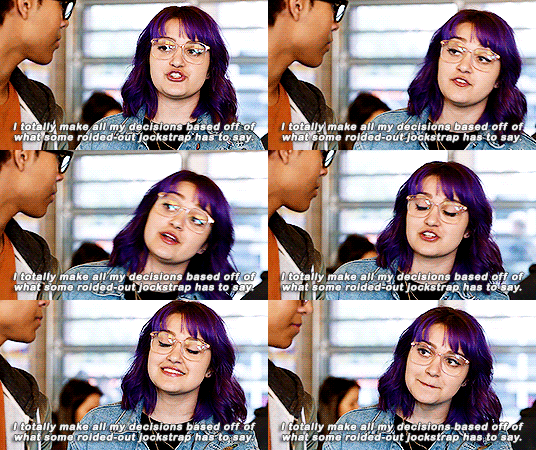
So this is a pretty shitty first impression of Gert. And the rest of the episode, most of her dialogue or actions somehow involve her either being somewhat hypocritical or a flat-out mean-spirited killjoy. She advertises a new club she's trying to start called "Undermining the Patriarchy," but then later reduces Chase to, and these are her exact words, "some roided out jockstrap" whose opinions only go as far as "what protein butter to use," while at the same time, objectifying him by staring creepily at his ass while following behind him as he's talking to one of his teachers. And this is just the first episode.


Speaking  of first impressions, Hulu filmed a non-canonical promo for Thanksgiving entitled "Not Your Typical Friendsgiving." The 47-second spot is our six teenagers sharing a Thanksgiving dinner together, at a table just large enough for all of them. It ends with a group of adults that are clearly their parents (their faces are invisible, but it's pretty obvious), in their big, red Pride ritual robes, popping up behind them and the kids looking scared, the final screen saying something like, "Now Streaming." The whole group starts the bit at least somewhat happy to be there, except Gert. Upon Alex remarking that Thanksgiving is his favorite holiday, she chimes in with, "Psh, of course it is. Hey, Alex, would you like this with a side of smallpox? Because that is what we served to the Native Americans, whose land we stole." Everyone is demonstrably uncomfortable in response, Nico even expressing that she's not hungry anymore. 

And okay, if you've read far back enough in my posts, you would know that I'm Lakota Sioux on my mom's side. And yeah, it pissed me off when she said it. But not at all you white folks. At the writers. Because it is true that the US was founded on murder and thievery and deception. That's a legit point, one that matters a HELLUVALOT to gals like me. And there are appropriate times to bring up how Thanksgiving is an easy way for people whose ancestors did the murdering and thieving and deceiving to feel better about/ignore their history (dare I say...  whitewash the thing? Eh?), while at dinner with your friends isn't. Not to be persnickety, but that's not the sort of thing you do during the event, you do it when invited and are politely declining. Or if you go, you don't bring it up, because it's pretty damn hypocritical for you to be actively partaking in Thanksgiving while disparaging it and its origins and all that jazz. 

Also, of all the people to direct that remark to, it's Alex. The Black kid. The kid whose ancestors were prooooobably slaves? Yeah, sure, blame his ancestors. Just plain tactless.

I digress... So once again, the real, valid point she's making is doing nothing to make viewers question the relevant geopolitical structures, but rather it's just making her look like an asshole that's entirely unconcerned for the social dynamics of the context in which she's in at the moment- and, in certain minds, no doubt, making them question the validity of her claims, rather than said geopolitical structures. Because it's made clear she understands things like conventional etiquette throughout the series; she just deliberately makes people uncomfortable with her "social critiques." And as this particular jab was about indigenous rights, I initially took it probably a little more personal than I should have. But when removing my personal baggage from the picture, it's disconcerting that a promo meant to draw in new customers that gives each character two lines at most, that its picture of Gert is one of mean "social justice warrior." 

Another angle she takes is "religious oppression." In the first couple episodes, she comes down hard on Karolina a few times about her family's religion, the Church of Giborrim. And it's juxtaposed against the other characters' perspectives, too. For example, in this same episode, Alex respectfully says he doesn't want to "interfere with [Karolina's] religion" by causing a scheduling conflict, an act of respect for Karolina's faith. And Karolina herself constantly talks about how genuinely happy her faith makes her because it's "positive and life-affirming," teaches her to see beauty and light in everything, everyone, and every situation. Gert, meanwhile, scoffs at the classification of "religion" for the Church of Gibborim, and asserts that "no institution has been as oppressive to women as organized religion."

And so again, the rub: 


Organized religion does have a shitty history in: re women. 

But instead, when she calls the Church of Gibborum a "cult" and says it's oppressive, she's bullying Karolina and insinuating she's stupid and duped, yet also complicit in the wrongdoing of all organized religion, and deceitful because she just "walks around with fake smiles, pretending to be happy all the time." So even though, sure, a legitimate critique of organized religion is absolutely necessary for good, inclusive feminist theory, Gert uses it as ammo to be cruel to someone she used to call a friend. And she reduces Karolina down to an antifeminist who only cares about "being a perfect church girl."

And what's hard is that it's made pretty obvious that most of her digs at Karolina are motivated out of jealousy because Chase shows signs of having, y'know, feelings for Karolina, while Gert has them for him. The most utterly disgusting bit of it comes across as passively homophobic, too.

In episode six, the kids are planning how to get to a party/gala thing Pride is putting on, and there's some talk about limos. Alex and Nico, who, at this point, are a fairly sold Thing, are going to take a limo together, and when Chase offers to get Karolina in his own, Gert says, "Ugh,


One limo, five stops."

Like, what the actual fuck? So what, queer people don't date? The writers co-opt the language of feminism to make a horrible blanket statement that disregards the experiences of GOD KNOWS HOW MANY NON-BINARY COUPLES/RELATIONSHIPS, and make Gert look like a homophobic asshole. It's reinforced by how uncomfortable the other kids look when she says it, too. And remember, this is in response to Chase offering Karolina a ride. The implication, here, is that feminism is really just the result of women's uncontrollable emotions. It gets further developed/pushed later in that episode, too. Nico and Karolina get ready for this gala together at Karolina's place, and Gert and Molly show up later, walking in on a pretty touching moment between the original two in the room. Later that night at the gala, Gert once again gets pretty homophobic for the sake of her feelings for Chase:


And Karolina, smartly, asserts that this would leave Chase available for Gert, who denies this is why. And when Karolina says she's wrong and ups the ante on her flirt game with Chase, Gert says, "Fine, enjoy, just know you aren't being honest about who you like."

This is pretty awful. In a different context, if we removed the Chase Factor, this would have been a beautiful scene. Lord knows queer teens have a hard time, and if it's true that Karolina is denying something because of that, a friend offering sincere kindness and support is exactly what she would need. But rather than being genuine, Gert's support for a potential non-straight identity in Karolina is presented as disingenuine and manipulative, as purely self-serving and hollow. And when Karolina calls it out, Gert acts as if she knows more about Karolina's own identity than Karolina herself does- and whether or not Karolina is, indeed, hiding something is beyond the point. Gert's assertion she knows "the truth" is arrogant and narcissistic, like she is the one that really knows what's best for Karolina. This is what some call "policing"- another thing antifeminists like to say is that feminism does too much moral grandstanding and "this is how you should behave"-ing, the "you don't really know what's best for you because you've been brainwashed by the patriarchy" condescension that actually does push people away from feminism. 


I should point out that Karolina is presented as her counter, though: While Gert is constantly pessimistic and mean, Karolina is optimistic and kind. Like in the first gif above, she stands up to Gert on more than one occasion, such as when she goes all in with Chase after Gert's "are you gay for Nico" bullshit. She also responds to Gert's "but we killed the Natives" remark in the Thanksgiving promo with a sweet declaration of her happiness to be there with her friends.  And her retort at Gert in the first episode during the "your 'church' is a cult and oppressive" bit, it kind of sums up the problem with Gert:

"You call yourself a feminist, Gert, but no one cuts down other women more than you do."


And this is a glorious window into just how much of Gert is made of straw. Because one of the big arguments antifeminists use against feminism is that it's "actually" harmful because it's "policing" and in itself oppressive and such. "If women want to be cheerleaders, isn't trying to stop them worse?" "If women want to practice [insert name of faith here], isn't it worse to tell them they can't?" Etc. And I think I've said before, I'm  a feminist that believes in a woman's own individual power over her body, her life, and her ideals. If a woman chooses to do A Thing, it's her choice. There's an addendum about knowledge and understanding and full internalization of the full range of choices available in a given context, but the example I usually  give is I have a Master's and would be happy to stay at home with the kids if my husband made enough money- not because I feel like I "should" do it, but because I grew up with a mom at home, and feel very lucky to have experienced that, and feel as though I would be good at it and want  to be as close to my kids as I am to my own mom. In itself, it has nothing to do with patriarchal structures, and I think that even if women do what's, on its surface, considered "upholding" the patriarchy, if it's done for reasons outside the parameters set in patriarchal structures, it can still "dismantle" it. 

And yes, that may sound like I'm actually giving a passive go-ahead for patriarchal norms, but this post isn't really about me, it's about Gert. If you want more on that, ask in the comments, but for now, just understand that I'm getting at how Gert's brand of feminism is the kind those against feminism point out when trying to argue against it. She's your quintessential "FemiNazi." Her constant finger-pointing and accusatory remarks make her the straw feminist of every intersectional feminist's nightmares, including your author, right here.

And let's not forget how in episode six, she pretends to be attracted to two guards at the Pride Gala, using her feminine wiles to clear the path for Alex and Nico to sneak upstairs. She isn't vocalizing a bunch of feminist taglines during any of these scenes, but it stands in stark contrast to the ideals by which she proportedly lives. This is more of the hypocrisy, then- women have been oppressed since the dawn of time, but it's totally okay for a woman to seduce a man to get what she wants. It's like something straight off of an MRA site, one of those "the femiNazis will do whatever it takes to get what they want" kind of rants. They'd talk about women faking feelings/attraction in the same breath (read: paragraph) as accusing "most rape victims" of being liars. The whole bit put a sour taste in my mouth. 

Okay, so now, Chase. I said before that she reduces him down to a dumb, sexy jock. This kind of goes to extreme places in episode three. She and Chase are snooping around his dad's workshop when they find a pair of X-ray goggles. Gert puts them on and, of course, starts... sizing up... Chase. 


So this is pretty gross. Calling it sexual assault is a bit strong, even for me, a survivor. But something like, I dunno, sexual misconduct? I mean, she sneaks a look at him with the goggles, denies it, and then makes a kind of snide remark about "scientific curiosity." She completely violates him, his trust, and his body, and then makes a shitty joke about it. Then? Then, when he gets the goggles in her parents' lab, she conveniently finds a lead apron, and when he catches onto her, this happens:


SERIOUSLY?!!??!!?!?!??!!?!?

This is the kind of hypocritical BULLSHIT that gets the menfolk's panties all up in huge wadded twists. The kind of double standard that MRAs warn about. The idea that feminism is about "revenge" with men, about "getting back" at them. Yes, it's about leveling the playing field, but

FOR THE LOVE OF GOD NOT LIKE THAT!!!!!!

This is the most egregious, disgusting, rage-inducing bit in the whole show. This pisses me off way more than anything the parents in the show have done yet. Which is why I wanted to save it for last. Because it genuinely confuses me. I can't tell if the writers are trying to push a specific conservative agenda overall, or if they're just trying to make modern liberal philosophy look bad. I mean, let's also consider the fact that when Gert has to bail on her own club ("Dismantling the Patriarchy," remember?) and some other teens start it for her, she basically mocks them and acts as though they're an inconvenience to her. And this, again, is another myth about feminism, that feminists are only actually feminist when it's convenient.

And I feel like her mockery of these specific teens is how we're supposed to feel about feminism and the complex web of ideals wrapped around concepts like social justice and equal rights. She scoffs at them the same way her behavior makes us, the audience, scoff at her.++

It reminds me of The Big Bang Theory, in that however much that particular show passes itself off as a show for nerds, the nerds' nerdery is the butt of 85% of the jokes (the rest of which are Sheldon's ASD, sexual puns, or gender). While Gert's jabs aren't the main punch of the show, they're the ones that stand out to me the most. Because so much of the marketing is about how this group of teenagers "comes from diverse backgrounds" and they "find common ground" when investigating their parents together. It implies progressivism and a liberal bent. Yet the only character overtly expressing liberal ideologies looks like a bully. And I can't help but think that, since the show takes place in a super wealthy area in L.A. (there's a comment about Compton in a flashback for Alex's parents, so yeah), since all of the families in Pride are super stinkin' rich, that maybe the writers want her to look out of place because her ideas are out of place in such a well-off area, and to them, the writers. Out of all of the teens, she seems to be the most out of place, even more so than the one that does a Wiccan summoning ritual in the pilot. 


And this isn't done like one of those stories where there's a lone voice of sanity in a cacophony of draconian ideas. We aren't meant to sympathize with her ideas, we're meant to scorn them. We're supposed to think Gert and her beliefs are selfish, nefarious, hypocritical, and toxic. There are a few times where she seems to kind of come through and be kind, but her feminism and belief in social justice are still used as a punchline every episode. And it gets to me, under my skin. It's disappointing and, as I said, confusing. 

I can't imagine the confusion a kid would feel, one struggling with their identity. One that knows there's inequality and oppression, but isn't sure what to do or maybe even think or feel about it. Harping on the "diversity" thing, what about that queer kid of color watching? When they see stuff they believed in, presented as "bad" in a show they're supposed to relate to? Or the liberal kid in the conservative household that has been told by the adults in their life that they're wrong, what happens when this kid sees the adults' views ostensibly validated because Gert's meant to look like an asshole?

So I don't have an answer. Because 
even if they mellow out and stop having her pull the "there are starving children in Africa"-type bullshit all the time, they drilled it so hard into the heads of their viewers that first episode (again, a whole page-worth of dialogue), it's there. It's part of her identity as a character, now. As a person. There's no escaping it. The only way to do it is to have her dramatically denounce feminism and the fight for equality, which would serve the same purpose as continuing with more of the same. There's legitimately no saving her character. And it breaks my heart. Through Gert, the writers are asserting that feminism is bad, dirty, something to avoid. And that breaks my heart, yeah, but also pisses me the Hell off.

Because I am so. Damn. Sick. Of us feminists getting a bad rep. 


I'm so. Damn. Sick. Of these straw feminists becoming the poster children. 

I'm so. Damn.  Sick. Of people that actually have a lot of feminist ideals at the core of their politics/worldview/etc. turn up their nose at the word "feminism," that interject, "NONONONO!" in a panic when someone has the audacity to describe them as a "feminist" in their presence.

"Feminist" isn't the f-word.


It's FUCK.


*I was always a Team Spike kinda gal- not because of the "bad boy" thing, per se, but because he had a much better character arch than Angel. He tried so damn hard to be good, and went from Point A to point, like, S. Angel was flat and boring- any development was forced because he sort of transformed, not because he actually made efforts to change as a person.

**This is actually another thing that kinda bothers me about the show- Molly's treated more like she's in middle school than a fellow high school student, by both the other kids and the adults. Granted, she does a couple things that certainly seem to place her maturity level far below those of the other teenagers, but I see them as reactions to how everyone treats her like a "baby," reactions that wouldn't have happened if they just treated her like, well, not a baby. 

***Although, yeah, there's definitely a critique of how his former friends show back up threatening violence. There's a trope about how Black characters are often depicted as "unable" to "escape" their pasts if those pasts involve "the hood," so to speak. I can't quite parse it out right now, but it's there. Still, knowing that Geoffrey's rise from Compton to super-rich L.A. is mostly because of their deal with "Jonah," the mysterious immortal figure with powers, is important because it demonstrates the power Jonah has.

+Full disclosure: I love her. And I'll just say here,  I think a lot of the hatred for her stems from the fact that she points out the shit that the white nerdboiz don't want to admit about the media they love- they can't admit their video games/comics/etc. are racist or sexist, because that would mean they were complicit in those ideals. And they'd rather shoot the messenger than do something about it that would, you know, lead to change. And also, projecting their own self-loathing onto her.

++I do think the fact that they essentially kick her out in the seventh episode is meant to be a reflection on Gert herself, that her attitude pushes everyone away, even though one would think she should be super close to and want to be around all the time, people who seemingly share her core beliefs. And, there's also the "exclusivity" thing, too.